
À la une
Logic and cognition : recent advances - 16 octobre 2026
Publié le 7 octobre 2026 – Mis à jour le 15 octobre 2026
Lieu(x)
DERNIERE MINUTE
changement de lieu :
l'atelier se tiendra au KAP, box 020
changement de lieu :
l'atelier se tiendra au KAP, box 020
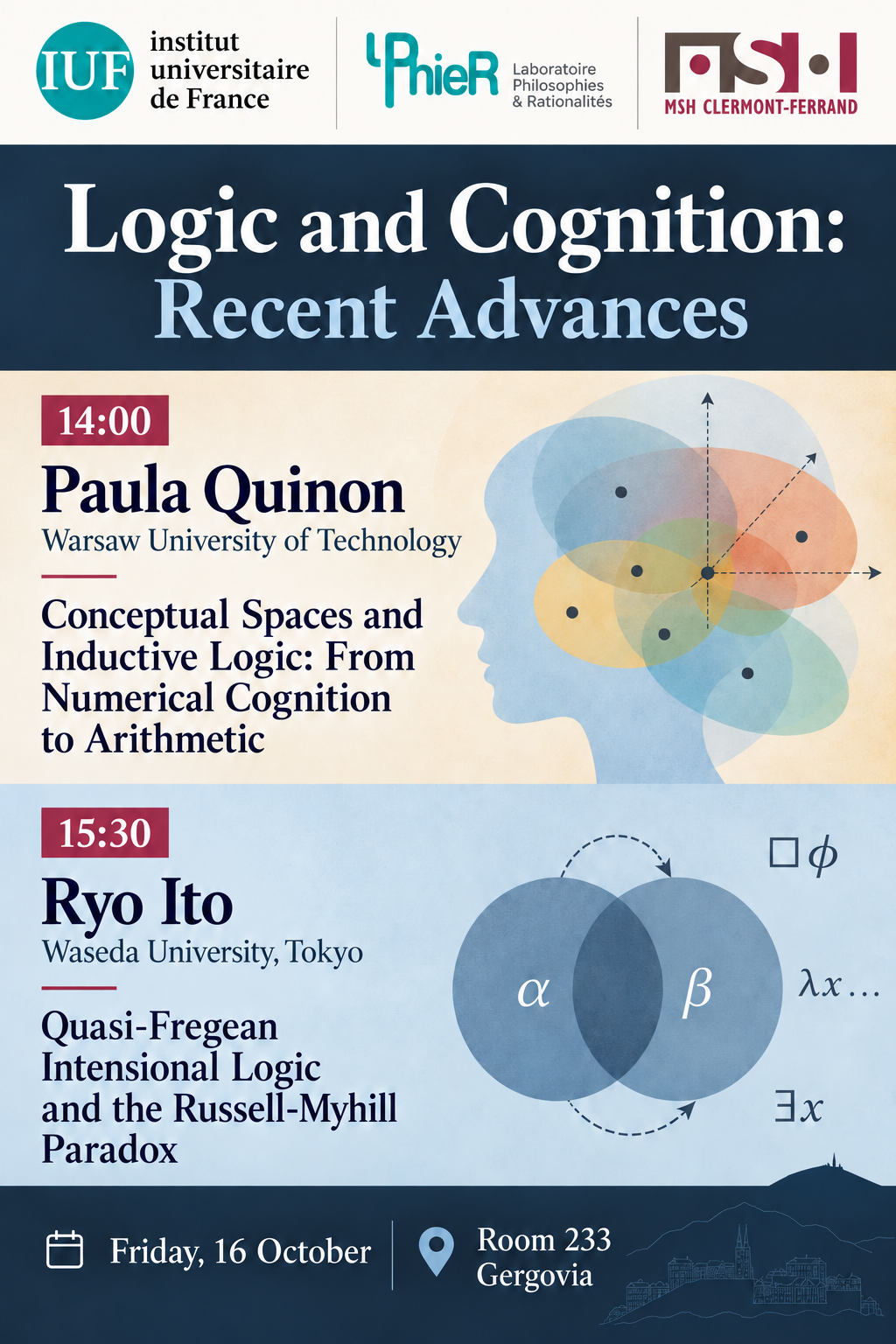
Le workshop accueillera Paula Quinon (Institut Polytechnique de Varsovie) et Ryo Ito (Université Waseda, Tokyo) pour deux interventions :
14h : Paula Quinon
Conceptual spaces and inductic logic : From numerical cognition to arithmetic
15h30 : Ryo Ito
Quasi-Fregean intensional logic and the Russell-Myhill paradox
Abstract : In this paper, I present a formal presentation of the Russell-Myhill paradox by developing a version of intensional logic that is quasi-Fregean in two senses: it can express the relation between sense and reference, and it is what (I think) Russell attributes to Frege in `On Denoting'. In the literature, it has been customary to formulate the paradox by assuming (or proving from some given axioms) that every reference has a sense. Yet, if Russell's original formulation of the paradox is valid, it should be possible to formulate the paradox without this assumption. I attempt to show that even if we draw the distinction between sense and reference, it is possible to formalise the paradox without assuming that every reference has a distinct sense.
14h : Paula Quinon
Conceptual spaces and inductic logic : From numerical cognition to arithmetic
Abstract : This talk is part of a project devoted to conceptual spaces as a tool for modelling mathematical concepts, and it focuses on the natural numbers. Conceptual spaces entitle us to objectivise individual number cognition. A model in conceptual spaces is a Carnapian explication, which turns an intuitive pre-scientific concept into a formal one (Carnap 1950). The explication stipulates that concepts are convex regions, and convexity makes it possible in general for individuals whose conceptual spaces differ to reach a joint meaning (Warglien and Gärdenfors 2013). The core cognitive systems, which I model in conceptual spaces, provide the properties that amount to the early concept of natural numbers: the individuation of objects, the approximate estimation of quantities on the ANS dimension and the regularity of the “one more” step. The rest comes from interaction with culture, through numeral systems, computation and the formulation of theories (Menary 2015; Pantsar 2019). A common objection to this approach is that it yields only simple operations on small numbers. In response, I show, following the probabilistic account of Walsh (2014a,b), how much of arithmetic can be obtained from this basis by inductive logic. Verified instances confirm the general laws that define addition and multiplication, and these laws suffice to establish the result of any particular computation, however large the numbers involved. Finally, I point out what inductive logic does not provide: the acceptance of mathematical induction for every property, and the reference of the numerals to the sequence of natural numbers. The talk is part of a larger plan to justify that the intended model of arithmetic is intended for a reason, namely that the way we acquire and use numbers explains why we single out one of the many models of Peano arithmetic.
Research funded with a Polish National Research Center grant OPUS21.
15h30 : Ryo Ito
Quasi-Fregean intensional logic and the Russell-Myhill paradox
Abstract : In this paper, I present a formal presentation of the Russell-Myhill paradox by developing a version of intensional logic that is quasi-Fregean in two senses: it can express the relation between sense and reference, and it is what (I think) Russell attributes to Frege in `On Denoting'. In the literature, it has been customary to formulate the paradox by assuming (or proving from some given axioms) that every reference has a sense. Yet, if Russell's original formulation of the paradox is valid, it should be possible to formulate the paradox without this assumption. I attempt to show that even if we draw the distinction between sense and reference, it is possible to formalise the paradox without assuming that every reference has a distinct sense.